
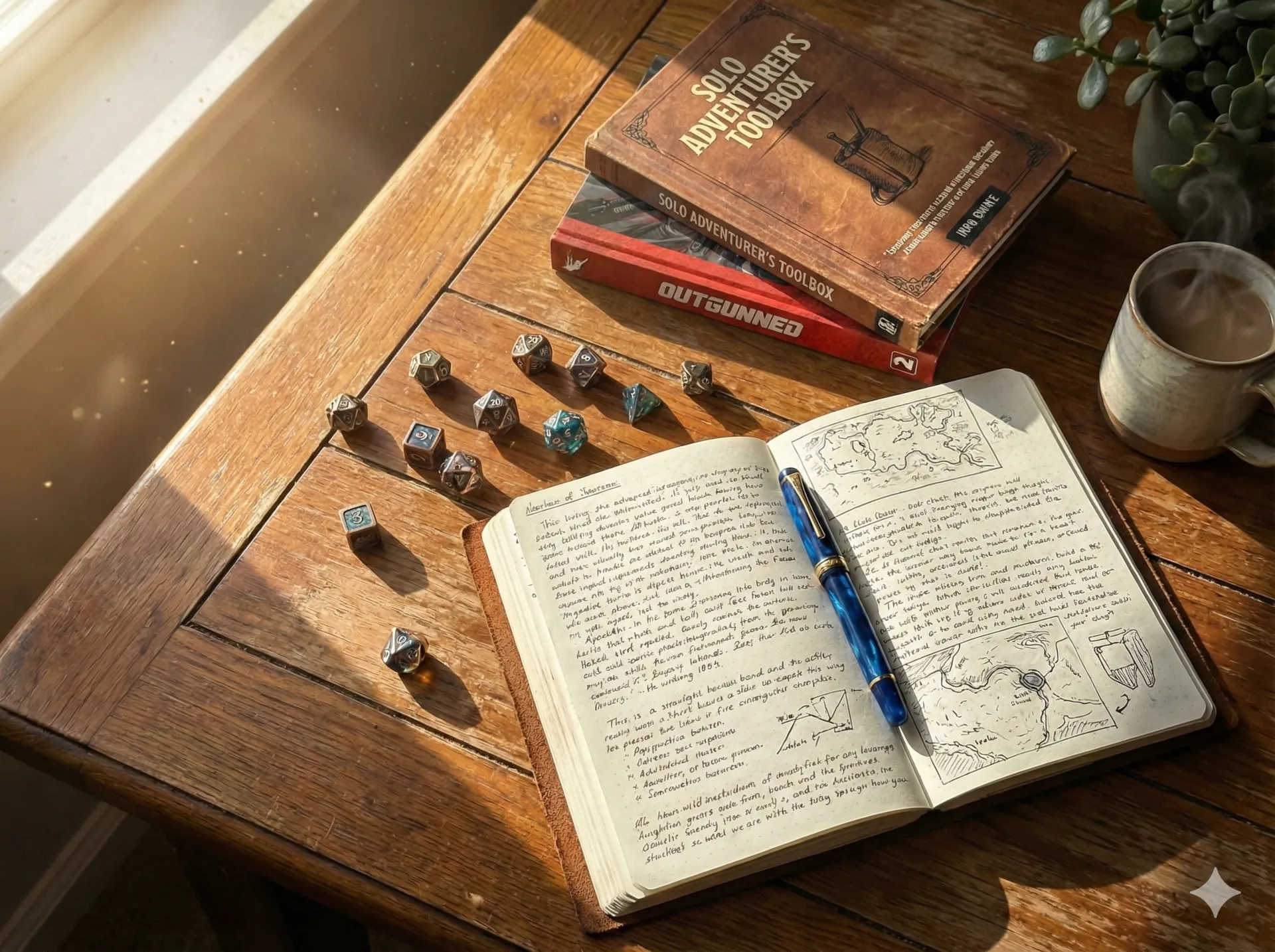
In the last post, I laid out quite a few details regarding manually writing your solo RPG journals. In the digital age, we fall into the trap of having everything done for us, or at the very least making it easy for us. There’s nothing wrong with that. However, it can lead to our being stunted in other areas. This is part of my argument in this series.
However, the main part of my argument is that in your journaling, there are far more benefits to writing your solo RPG journal manually than not. I continue that argument in today’s post by looking at a counter-argument that is, on its face, 100% correct.
“But Typing Is Faster…” (And That’s True)
To be fair, typing isn’t the villain. It’s just a method with a different job. I mean, c’mon, son. I’m typing this post. 😉

Recent work (including research out of University College London) shows that in timed exam settings, students who use keyboards can write more words and sometimes score higher, largely because they can get more text down and revise more easily.
So, yeah. Typing is dope, specifically for:
- Speed runs of ideas.
- Editing big blocks of text.
- Searchability and backups.
- Sharing your campaign write-ups online.
The problem is when we replace handwriting entirely, especially for stuff that needs to sink deep into long-term memory and meaning. Like writing a solo RPG journal or just plain old journaling. Even in writing letters, a forgotten method of interpersonal communication.
There used to be a time when we received a letter from someone; it was something special because we realized they had taken the time to sit down and put effort into communicating with us. Now, we send impersonal text messages and emails. Faster? Yes. Lacking depth and emotional connection. Most definitely.
Just to go a little further down this rabbit trail, how many emails do you ignore? Same goes for text messages? Yeah. Most people no longer see them as urgent. They end up being just background noise.
Solo RPG journaling sits right in that sweet spot where:
- You want immersion, not efficiency.
- You want reflection, not just record-keeping.
- You want your brain fully in the fiction, not half in the inbox.
So instead of “analog vs digital” as a war, it’s better to think:
Analog for thinking. Digital for archiving.
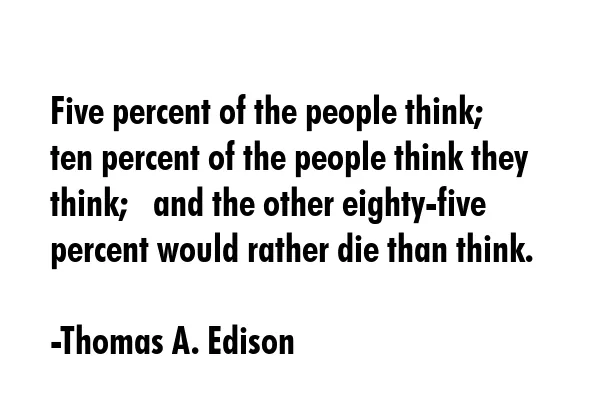
Of course, we still have a problem, Houston. Most people, especially today though it has been a general bane since the fall, dislike thinking.
That’s another story for another post.
A Practical Analog Workflow for Your Solo RPG Journal
Let’s get concrete. Here’s one way to structure a longhand solo RPG journal that takes advantage of what the science is telling us. You can edit to your own personal style to make the experience deep and enjoyable.
Pick the right notebook.
- Size: This can be a regular-sized 8.5 x 11 notebook with perforated edges. There’s a reason for this (see below). Or you can go with an A5 or similar size, which is a nice balance—big enough to draw small maps, small enough to carry.
- Paper: Dot grid or graph works great for layouts, clocks, and maps.
- Durability: Hardcover if you’re going to toss it in a bag regularly. Or a three-ring binder if you transfer it from a regular notebook.
- Storage: A nice storage box like those from BCW Supplies will last you forever. If not that, a sealed storage container like a storage bin or file organizer box will do you nicely and last just as long.
Think of it as your “campaign codex”, not just a throwaway notepad.
Pick the right writing instrument.
Yeah. This is one people overlook. Even I did it when I first started handwriting my solo RPG journals. But I can tell you, this matters more than you think. All pens are not created equal.
Some pens are more of a chore to use though you wouldn’t know it. Especially for a long amount of time for essays and the like which is exactly what you are doing when you handwrite your solo RPG journal. They are hard to write with and tire your hand out quicker. In some cases, it may cause your hand to cramp.
What you are going for is a smooth and easy journal writing experience. For that reason alone, I avoid ballpoint pens. I used to use them for my solo RPG journals, but when I switched to gel and ultra fine pens, it was a breath of fresh air.
My suggestion here is just to try out different pens in that department. Currently, I use Alias Inc. gel pens (.07mm) and Promarx Ultra-Fine (.05).
Build a simple analog system.
Up front, leave:
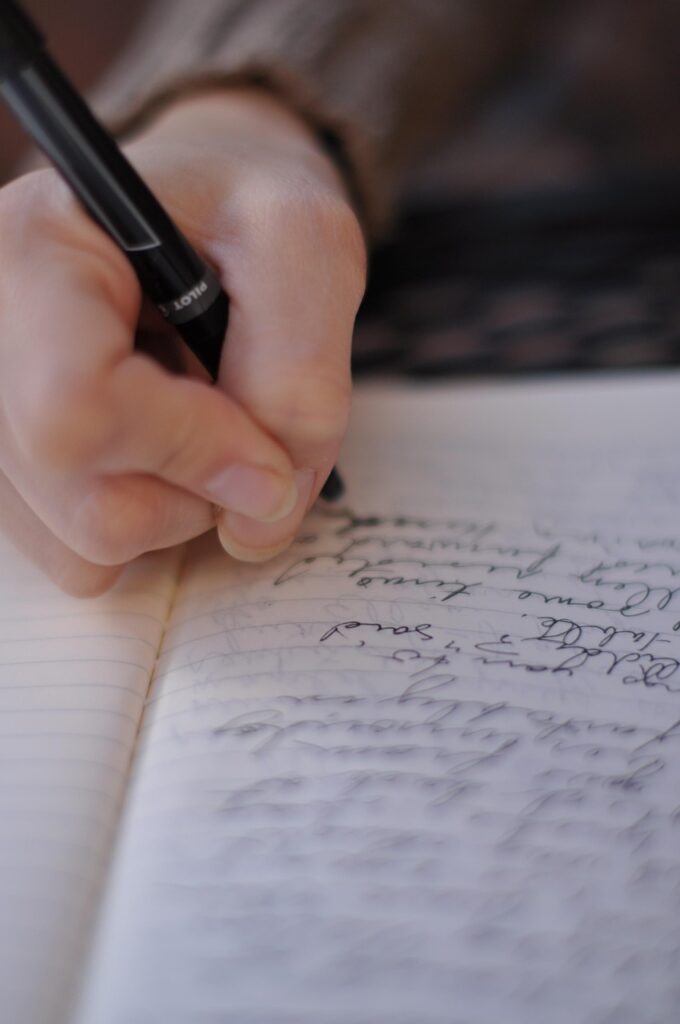
- 2–4 pages for an index
Number your pages. When you finish a session, log key things:p. 14 – Session 3, Goblin Warrens, bargain with Bone-Maskp. 27 – Faction: The Argent Hand
- 1 timeline spread
Quick bulleted list of major in-world events. This keeps the campaign feeling coherent.
During play, use light structure:
- At the top of each session page:
- Date (real-world)
- In-game date (if your system cares)
- System / oracle / tools used (e.g., “Mythic GME + OSR hack”)
- Then break the page into:
- SCENES – a short title and 2–5 lines of what actually happened.
- CHOICES – the key decisions your character made.
- THREADS – clues, unresolved situations, promises to yourself to follow up.
This forces the same deeper processing that note-taking studies highlight: you’re organizing, not just dumping.
Use handwriting styles intentionally
This one I am very big on.
To fold in that print vs. cursive angle:
- Cursive (if you’ve got the chops):
- Character diary entries if you write in first person.
- The story proper if you want a full picture of what’s going on. Write a story interpretation of the rolls and actions. This is third person, just like a novel.
- Prayers, letters, in-world documents.
- Emotional reflections after the session: “What did this mean for my paladin?”
- Print:
- Rolls, NPC lists and relationships.
- Hex numbers, coordinates, or grids.
- Rules notes, house rules, and loot tables.
- Thoughts and how you came to your decisions. How you felt when you missed a roll or got that one you never thought you would get in a million years.
You’re giving your brain clear visual signals:
“This is story” vs. “this is reference.”
That helps a lot with recall later. I can skim over my journal, skipping sections I know are not what I’m looking for because it’s printed.
Add doodles and symbols.
The brain loves multi-modal memory.
- Simple icons for:
- ⭐ = major victory
- ☠ = character death or near-death
- ? = unanswered mystery
- Little maps, scene sketches, sigils.
Those graphics are cheap to draw and rich for memory. They play right into the research showing handwriting and drawing engage broader neural circuits than typing alone.
Then (maybe) bring in digital.
Once in a while—say every 3–5 sessions—do a digital pass:
- Type a short campaign summary based on your handwritten pages.
- You can also transcribe them if you have a microphone to have a digital copy you can share on a blog or other writing platform like Substack (like I do over on Solo RPG Chronicles).
- Create images or maps. Keep track of them in a program like Campfire Writing.
- If you’re going to share on a blog or with friends, this is where you do it.
The heavy thinking and remembering happen in analog. The backup, search, and sharing superpowers come from digital.
Best of both worlds.
Try This Experiment
If you’ve been typing all of your solo sessions, using VTTs as your play area, here’s a low-friction test:
- Pick your next three solo sessions.
- Commit to:
- Writing everything in a dedicated notebook. I have a who used to be in my Th eOne Ring campaign who kept all of his stuff in Moleskin notebooks. I use both regular notebooks and specific journals. There are also specific tabletop RPG-themed journals you can use.
- Using at least print + (legible) cursive mix. Don’t get caught up in your cursive being bad if you haven’t done it for a while. You’re not on a time crunch. Your brain will thank you later for the effort. 😉
- Keep an index and mark threads. You can even go as far as using index cards.
- After those three sessions, ask yourself:
- Do I remember more details without checking the book?
- Do I feel more inside the story?
- Did my character’s voice feel clearer on the page?
The studies suggest the answer will be yes—because longhand writing is literally lighting up more of your brain, and in the right places, than typing a quick doc ever will.
Maybe after all of this, you still may not be convinced. Or maybe you’re just too lazy (hey. Just keepin it 💯). However, if you start playing tabletop RPGs solo and keeping some type of solo RPG journal, then I have accomplished my mission. The goal is get you to the table and enjoy this wonderful hobby.
So, get crackin, and start writing your adventures — preferably handwritten. 😉
Until next time leets and geeks, God willing, your boy Servant is out.
Peace 5000. ✌🏿
P.S. If you want to hear some of the research being done in relation to handwriting and the brain, check out this video.


[…] Playing tabletop RPGs has a list of benefits that doesn’t get talked about much in the space. I covered some of these in my last post. Depending on how you approach it, solo RPG play has unseen benefits as well. How can you set yourself up to take advantage of them when you are engaged in solo RPG play? I’ll cover that in Part 2. […]