

How It All Began
For those who are unaware, I started a Substack back in May of this year. It was an experiment to see what the big hubbub, bub, was about. Seeing that I have a tabletop RPG YouTube channel, I wanted to tie it to that. However, I also wanted to do something a little different from my channel.
That was the beginning of the Solo RPG Chronicles.
I had been playing tabletop RPGs solo for a little while, and I knew it was a great way to experience those games you had sitting on your shelf for years you never could get other people to play. Plus, there are a ton of advantages to playing a solo RPG over group play.
As I went deeper down the rabbit-hole of solo RPG play, I got further and further into areas most fear treading or don’t think about, hence this post.
I have a lot of notebooks. In more than a few of them are solo RPG sessions. When I started out on this journey, I instinctively wrote some of my sessions longhand. I wanted the old-school feel. Plus, something was … different when I did that. I liked the difference, so I kept doing it. My sessions were more enjoyable as a result.
When I played through the first season of the Solo RPG Chronicles, I wrote everything in Scrivener. Recently, I started season two and decided to go back to writing longhand in notebooks. The very thought of it made me excited. This is no joke.
Why was that? Why did I enjoy writing longhand like that (and in cursive to boot)? What was the difference I felt when I wrote in Scrivener versus writing in a notebook?
Asking those questions has brought me to the place we are in this post.
A Solo RPG Approach: My Premise
If you play solo tabletop RPGs, you already know the real game isn’t just on the table—it’s in your head.
Your character’s voice.
The twist you dropped three sessions ago that you pray you remember to pay off.
That NPC barkeep whose name you totally forgot because you wrote “Inn guy” in a random Google Doc three months back.
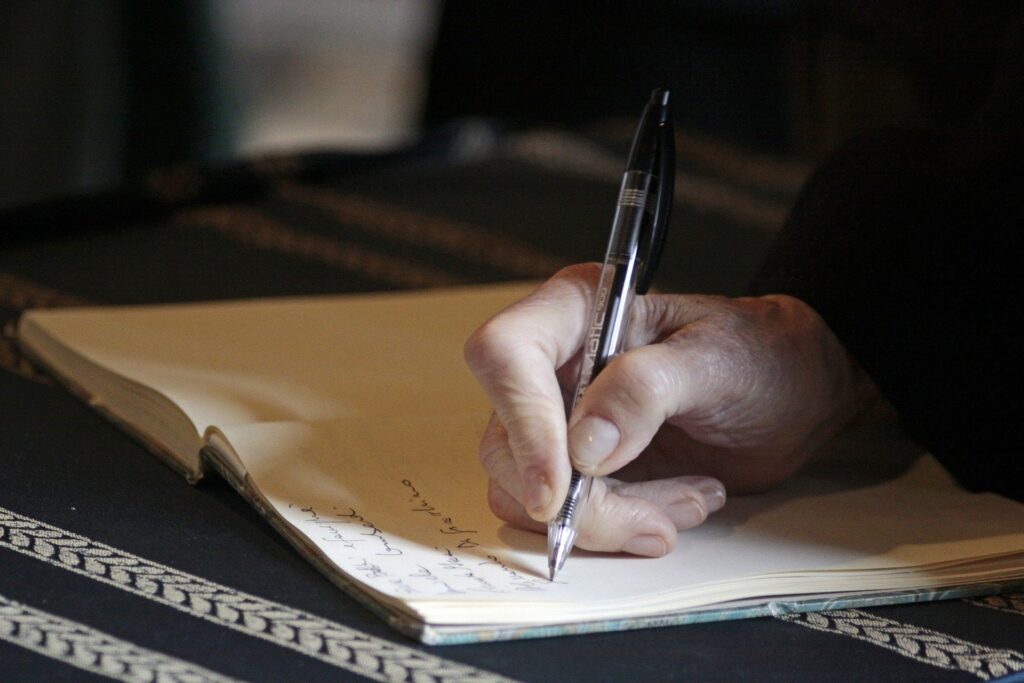
The question is: are you better off typing your adventure journal, or writing it longhand in a notebook?
Yes, I said it. Writing longhand. You remember that, don’t you? You use a thing called a pen to create words on a piece of paper. I know we live in a digital age, but I’ve got a surprise for you (or maybe it won’t be so much of one once you read this post).
You see, science is pretty loud on this: when it comes to memory, comprehension, creativity, and deep engagement, pen and paper have the edge over the keyboard (I’m putting it mildly). The fact we call tabletop RPGs pen and paper games now takes on an entirely new meaning.
Let’s walk through what the research says and what it means for solo RPG journaling—and then we’ll talk about cursive vs. print, and why a shocking number of younger folks can’t read cursive at all.
Handwriting vs. Typing: What the Research Actually Says
One of the most famous studies in this space is by psychologists Pam Mueller and Daniel Oppenheimer. They compared students who took notes by hand with students who typed on laptops. The students who wrote longhand didn’t capture as many words, but they understood the material better and did better on conceptual test questions.
Mueller and Oppenheimer summed it up this way: when you type, you tend to transcribe; when you write, you’re forced to process and rephrase, which drives deeper learning.
Later work has backed this up.
A 2021 study by Ihara and colleagues found that people who handwrote new words remembered them better than those who learned them by typing.
More recently, neuroscientists have gone under the hood. In a 2024 high-density EEG study, Van der Weel and Van der Meer found that handwriting “but not typewriting” produced widespread brain connectivity related to learning. They conclude that handwriting creates richer neural conditions for learning than typing does.
And a 2025 neuroscience review article put it bluntly: cursive writing in particular recruits broader neural networks than block-letter printing, with implications for memory and cognitive development.
Translating the science to solo RPG journaling
So what does that mean for you as a solo RPG player? I’m glad you asked. 🙂
When you type your solo sessions:
- You can go faster.
- You can record more raw text.
- You’re more likely to fall into “transcription mode” — just dumping events from the mind.
When you write your solo sessions by hand:
- You have to choose your words more carefully.
- You naturally summarize: “What actually mattered in this scene?”
- Your motor system, visual system, and language system all work together to encode those events more deeply.
That’s exactly what you want in a solo campaign: not a bloated transcript you’ll never reread, but tight, meaningful entries your brain actually remembers.
If you want better recall of NPCs, plot threads, and your character’s growth, the evidence leans hard toward handwriting.
Your Brain on Ink: Why Handwriting Hits Different

Neuroscientist Karin James at Indiana University has done some very interesting work here.
In one fMRI study, her team had pre-literate children either print letters, type them, or trace them. Later, the scanner showed those letters to the kids. The brain’s “reading circuit” lit up only in the kids who had written the letters by hand—not the ones who traced or typed them.
The conclusion: writing by hand helps build the neural network that underlies recognizing and working with symbols—the foundation of reading and meaning.
C’mon son. This stuff is real.
A 2022 educational article in Frontiers for Young Minds put it this way: when we write by hand, we see and feel the letter being written, see different versions of it, and pay more attention to what we’re doing, which supports better memory and learning.
And the 2024 EEG work I mentioned earlier? Researchers found that the fine motor control involved in handwriting engages more complex brain connectivity than typing, which they say creates “optimal conditions for learning and memory formation.”
What this means at the table
Solo RPG journaling isn’t just “note-taking.” At least it shouldn’t be. You’re:
- Inventing NPCs and factions.
- Tracking clues.
- Weaving together fiction across multiple sessions.
- Reflecting on your character’s choices.
All of that is symbol-heavy, meaning-heavy work—perfect territory for the handwriting advantage. This is getting deep in the paint with the creative process.
When you longhand your adventure:
- The act of forming the letters of “Lady Seraphine of the Gloaming Vale” actually helps your brain tag her as an important symbol in your world.
- The slower speed forces you to filter: “What’s worth writing down?” That filtering is mental processing, and mental processing is memory.
- You’re more likely to go on creative side roads with world building, describing things like banners, maps, or sigils—extra visual hooks your brain can latch onto.
Typing is great for speed. But solo RPG storytelling is not about speed. It’s about depth. When it comes to immersion, writing longhand beats typing, hands down.
Print vs. Cursive: Does It Matter for RPG Journals?

When researching this article, I wanted to know if there was a difference between writing in print vs. writing in cursive. I do that in my journals. Well, wouldn’t you know it, there actually is some science here.
A 2020 study by Askvik and colleagues, summarized in a more recent neuroscience review, used high-density EEG to compare cursive handwriting, block-letter handwriting, and typewriting in students. Cursive writing activated broader and more synchronized neural networks than print or typing, particularly in regions related to learning and memory.
Psychology Today’s coverage of this research notes that cursive handwriting appears to “prime the brain for learning” by synchronizing brain waves in the theta range (associated with memory and attention) and increasing electrical activity in learning-related networks.
In plain terms:
- Print (block letters):
- Easier to learn, more legible for many people.
- Still better for learning than typing, because it’s handwriting.
- Cursive:
- Requires more fluid, continuous motion.
- Engages more of the brain and may support better integration of memory, language, and motor systems.
Another recent summary from a Montessori school, citing the same EEG work, notes that cursive writing activates brain regions “linked to memory, language, and coordination,” and that this “helps students retain information and express ideas more clearly.”
For your solo RPG journal, here’s a practical take:
- If your cursive is rusty, borderline illegible, or non-existent (see below), print is still way better than typing for memory and engagement.
- If your cursive is readable, you might:
- Use cursive for narrative passages—your character’s inner thoughts, prayers, or dramatic scenes. Basically, the story itself.
- Use print for data—NPC names, place names, tables, items and their descriptions, dice rolls, or thoughts about what is going on and your thought process in how you will approach it.
You’re using your handwriting style as a layout tool:
- Cursive = story flow.
- Print = mechanics and out-of-character information.
The Cursive Collapse: A Generational Skill Gap
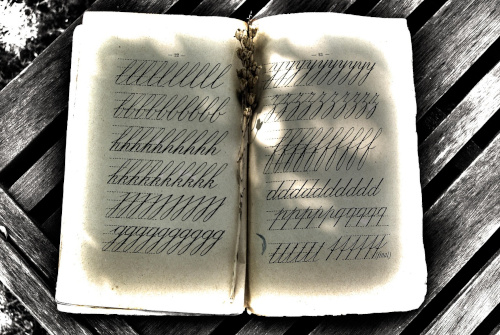
This, to me, is sad. Truly. It has to do with this current generation’s relationship with cursive.
In 2010, the Common Core State Standards were rolled out in the U.S. They explicitly mention keyboarding, but not cursive.
A 2023 piece on Yahoo News points out that because of that shift, many members of Gen Z were never formally taught how to read or write cursive at all.
There are no solid national stats on “who can read cursive,” but we have some indicators. It doesn’t bode well:
- A survey of handwriting teachers reported that about 37% wrote in cursive, 50% used a hybrid cursive-print mix, and only 8% printed exclusively—and that’s teachers, not students.
- A 2021 OnePoll survey (covered by multiple outlets) found that 45% of Americans struggle to read their own handwriting, and around 70% have trouble reading coworkers’ notes.
- An Education Week opinion piece from a middle-school teacher noted that by 6th grade, “most of the students… cannot read cursive well, let alone write it”, and that only about one student per year chose to write consistently in cursive.
- A 2021 article from a dyslexia-focused organization observed that “more and more children and adults cannot read cursive handwriting, or can only partially and laboriously figure out a word or sentence in cursive.”
So yeah—the skill is fading, and fast.
The flip side: states are pushing back. Education Week reports that in 2016, 14 U.S. states required cursive instruction; by 2018–2019 that was 19; and as of 2023, 21 states require some form of cursive instruction again.
From an RPG perspective, that means:
- Your handwritten solo RPG journal might literally look like a “mysterious ancient script” to some younger readers in 20–30 years—effectively the new generation of potential solo RPG players.
- Being able to write and read cursive puts you in a shrinking club—closer to reading old family letters, historical documents, and, frankly, a lot of older RPG material and GM notes. It is truly RPG elite.
If you care about legacy—leaving behind campaign journals your kids or grandkids can read—teaching them at least to read cursive isn’t a bad move. Teaching them to write it, even better, for the multiple reasons I’ve presented in this article.
Playing tabletop RPGs has a list of benefits that doesn’t get talked about much in the space. I covered some of these in my last post. Depending on how you approach it, solo RPG play has unseen benefits as well. How can you set yourself up to take advantage of them when you are engaged in solo RPG play? I’ll cover that in Part 2.
Peace 5000. ✌🏿😎
RPG Elite contains links to affiliate websites and receives an affiliate commission for any purchases made on or through those websites. This helps to maintain and support the RPG Elite Network and mission. Thanks for your support.

[…] In the last post, I laid out quite a few details regarding manually writing your solo RPG journals. In the digital age, we fall into the trap of having everything done for us, or at the very least making it easy for us. There’s nothing wrong with that. However, it can lead to our being stunted in other areas. This is part of my argument in this series. […]